Sunday, October 12, 2008

Stock : When to Buy at What Price

This explains how I buy stock, when to buy and at what price.  And why I don't really bother global recession and market fluctuation.  Actually that is not right, I do get very excited during down turn.  Its not often you get this kind of opportunity knocking on your door.

There are a lot of reasons and fundamentals behind this method but here I will just list down the practical steps now.  Explaination to follow in future posts.

Buying a stock should be EXACTLY like starting your own business !

1. find out the historical EPS ( for the past 10 years if available )
2. determine the EPS growth rate from #1
3.  by using this EPS growth rate, forecast to future EPS ( ie.10 years later )
4.  pick a reasonable PE for your stock
5.  use PE from #4 and the future EPS from #3 to calculate the Future stock price
6.  decide a return rate you want to achieve ( ie. 15% )
7.  Backdate the future stock price in #5 to today's price using interest rate in #6
8.  decide a safety margin ( ie. 50% ) and finally you have your target buying price !

There you go, When the stock price is lower than #8, BUY !!

example :
1. EPS is 0.28 to 1.12 in past 10 years
2. so the growth rate is about 15%  ( you can use rule of 72 )
3. 10 years later, the EPS will become 4.48
4.  PE = 10 from magazine/newspaper
5.  stock price = PE x EPS = 10 x 4.48 = 44.80
6.  15% means doubling every 5 years or doubling twice in 10 years
7.  44.80 / 4 = 11.20  ( 11.20 double twice in 10 years becomes 44.80 )
8.  11.20 / 2 = 5.60

So if the stock price goes below 5.60, I will buy.


Saturday, October 11, 2008

Finance Big Bang Theory

I have this Big Bang theory about Finance ...

At First, there Was Nothing,
Then there is Everything !


Long long time ago, we exchange goods for a living.  Sometimes I asked for 4 chickens to exchange my 1 bag of rice, but some other times, my friend is only willing to give 3 chickens.  So as times go, more and more people do not like this constant changing of 'price' and they want standardization.  So 'Money' is born.

We look down and there are some stones on the ground.  First we 'define' the chicken as 10 stones, since my bag of rice is 4 chickens then my bag of price is worth 40 stones.  So we started collecting stones instead of keeping too many cows and sheeps at home to represent our wealth.


It was all fine within our own family and friends because we trust each other.  Then some stranger came and just pick up stones from the ground to buy my rice.  Soon I ran out of rice and he has all the rice, so basically he took over my rice business and started to control pricing in my town.

So we need some special way to identify our special stones.  I started marking all the stones that I used to buy and sell things.  The chicken guy did the same.  Soon all sort of marking stones are in the market and guess what ?  A stranger came in and arbituary do some marking on the stone and took over the chicken business.

Then we learn that we have to 'standardize' the marking on the stones and it is too big a task for us because we are already full time producing rice and chicken.  The stranger volunteer, "Since I am able to twist all the systems you guy come up with, apparently I am a smarter guy in this area.  So if you let me come up with a special marking stones for you and everybody use that stones, there will be no problem !"  He ended with a strong .. " Trust me !".

So the first 'modern day money' is born. It is a piece of metal with hard to replicate marking represending the value of the stones we used before - the stranger called it coin.  So all of us including the rice and chicken producers keep our stones in the stranger's house.  For each stone we deposit there, the stranger gives us 100 coins.  Since then our buy and sell activities are better managed.

In case you haven't figured out yet,

the stone is called Gold today
and the stranger's house is called Bank

Our Stones


The Stranger's House


Friday, October 10, 2008

Personal Finance RISK - another Myth

A very common comment in Personal Finance is this ...

The Higher the Return,
The Higher the Risk !!

I agree with this if I am a general public.  I also like it if I am discussing this in a philosophical class.  But in practical life in Personal Finance, it doesn't help much.  It just tell me not to be greedy.  But it doesn't tell me what to do with my portfolio.  So the myth buster is as below ...
Generally higher return comes with higher risk,
For Those Who Don't Know ANYTHING !!
If you know exactly what you are getting into, has prepared for the worst and expecting the best from it, so ideally there is no risk at all.


For example,

standing expose in high place is dangerous,
especially if you are not used to it.

But high rise workers do that everyday,
they know very well what to do,
and what not to do.

They check all the safety cables,
before going up,
and look for secondary fall place,
before making the next step,
just in case they fall,
they have had enough compensation,
for their own or their loved ones.

Day in day out, they are used to it,
and they are not over confidence,

Its very risky for you,
Its not that risky for them.


Some may claims that the risk is the same to all, just that one has mitigated the risk and another not.  Well, again in practical, if you have already mitigated the risk, the risk is gone and there is no risk anymore - ideally.

Back into the high rise example, if you are an office worker and you think high rise is risky.  So you decided not to go to high rise building.  That is also one way to mitigate risk and there will be NO RISK AT ALL if you never go that place.

So the fundamental about risk is,

The more you learn and know about it,
the less risk it is to you personally !

So yes generally higher return higher risk but you are not a general public, you just need to know what you have to do for youself so that you can achieve higher return without the same high risk in your portfolio.  Thats why its called "Personal" Finance and not General Public Finance :)

Property Myth in Personal Finance

Property is one of the most interesting topic in Personal Finance, becaues it carries a lot of myth and paradox with it.

Property is one of the few finance tools 
that bank is willing to lend you money
 before you buy it.

Because of that alone, you can do almost ANYTHING you want with it.  Imagine this ;
1.  you see a good property
2.  you find someone who will rent it
3.  you convince bank how much its worth is and you can repay them back
4.  bank lends you money
5.  you buy the property with bank's money and rent it out
6.  you collect rent and pay it back to bank
So basically you have just own a property for FREE !!  This is just one way.

Unfortunately, because of that imagination as well, many people got into trouble when they put Property into their Personal Finance Plan.

As mention before, Income is different than Finance Planning.  You have to be very clear what you want to do with Property, either it will be your Income or just a portion in your Personal Finance.

Property as an Income 
Just like other incomes you get from your job or business, you will have to work on it.  You work smart and hard for it.  Using property to earn income is very much like running your own business.  Each property you own will become a business that you run to achieve a goal that you set for your business.

Property in Personal Finance
Personal Finance is about portfolio (click here to read more). A finance tool inside this portfolio is one that already has a proven system running.  All you need to care about is to select which system to join and you will get return without doing much about it -  Passive Return or Money earns Money.

====
So if one were thinking to add property into his personal finance planning, 
and mistakenly treat it as an income source, 
but do not have the persistency to run the business with full focus, 
then most probably he will be very disappointed by the result.  

like wise,

if someone is hoping to gain big money from property, 
but join some property fund instead of buying any, 
then he will most probably be dissapointed by the return rate.


The Solution - Portfolio

This marks the First milestone of this sharing in Personal Finance Fundamental - the solution !


Since the post of "now Finance Planning starts ...", there is a wealth pyramid built.  I want to re-emphasize that everyone's should build their own pyramid.  And everyone may use different material to build it.


And I also talk about Life Line - a simple drawing of your life and what you like to do with it.  The right shows a person who likes travelling. 

I also mention none of the single finance tools, insurance, mutual fund etc are the solutions.


What we want to do is to build a pyramid that help us achieve what we want to do with our lives.  Since what we need may change over time, the pyramid we built should be flexible enough to cater for all needs as well.

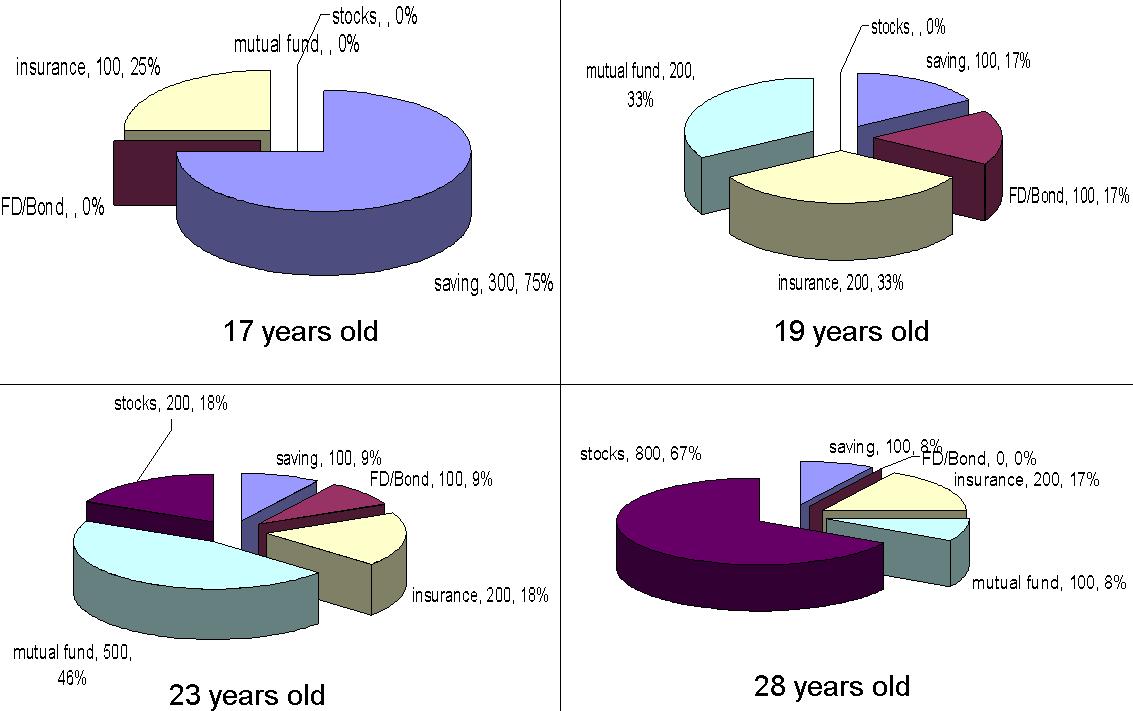
As such, what you need is your own portfolio - a set of different distribution to different finance tool at a specific point of time.  Below is an example.


Whatever your choices are, different finance tool will bring you different return.  Depending on your current situation and your need in life, there is a gap.  Bigger gap requires bigger tool to cover it, as long as the tool is NOT TOO BIG until you cann't handle it.

This portfolio changes from time to time, if needed.  For example, a young man who started working has not much commitment yet so he saves most of his money.  Then he wants to buy a house or car, so he increase the return of his portfolio by taking up mutual fund, stocks etc.  Below is a snapshot of what I had ...


After that I started my own businesses and the portfolio would look very different than ordinary.  Business goes up and down.  I was lucky that I started my personal finance planning early so that during the down time of my business, I was able to 'borrow' money from my portfolio to assist my business cash flow challenges.

So I am still alive today :D

Thursday, October 9, 2008

Comparison of currencies against MYR 2008 Trends


The plotted data was from Jan1 to Oct9 this year. This shows the value of other currencies as compared to MYR. The data has been index to Jan1 values so that it's easier to compare the different currencies to each other. (For example KRW has dropped from 1.0 to 0.7; this means if you had bought RM1000 worth of KRW in Jan1, today, it's worth only RM700).

The value of EUR increased for much of 2008, and then started dropping. By Oct1, it's value was below that at the start of the year (y-axis == 1.0).

GBP spends much of the year below 1.0, moving up and down. The current value is about 7.5% lower than at the start of the year. You can see it's pretty low. Lower than any other time in the year (except 1 month ago).

USD tracked GBP for much of the year, until it began to diverge about 2 months ago and started going up. It's now at the highest point this year.

JPY is increasing higher than even USD. If you'd bought RM1000 of JPY on Jan1, it'll be worth RM1175 today. KRW is dropping like a stone. May be its a good time to go holiday in Seoul? smile.gif

extracted from Lowyat Forum
data obtained from Bank Negara

Case Study : Buy Stock IOICorp 20081008


This is a short post just lay down my scratch pad showing how I determine the value of a stock without step by step guide.

The table on the left is IOICorp EPS trend in the past.

If I take 1990 to 2006 for calculation, the EPS growth rate is 28.8%

If I forecast future EPS for the next 10 years using above growth rate, I would get 9.28

Assuming PE is 16, the Future Value of this stock is $148.48


The numbers used in above calculation is up to 2006 only, so let's do a quick check.

1.  2008 Jun EPS is 0.991, so EPS growth rate used above is ok.
2.  There is a 1 to 5 split on Jun 2007, so all calculation above should reflects that too.

After 1 to 5 split, the Future Value of the stock becomes $29.696

My target return for this investment is 15% in 10 years, so $29.696 future price translate to $7.424 today price.

I also use 50% as a safety margin so that if things go wrong I can still feel confident that I am in good shape, so finally I think this stock is worth $ 3.712 !!

The last price I got for this stock is about RM 3.7   Seems like the price of this stock is ready to be bought in.

All I need to do tomorrow is to reconfirm PE value and read some of the latest company report on their future plan, any change of management etc.  If nothing serious came out from those, I am buying this stock NOW !!


=== 2008 10 09 ====
Sorry guys, just did a check this morning ... PE for plantation is at most 10x, so this is still a NO GO stock.

Wednesday, October 8, 2008

Bond

Bank lends your money to others to earn an income and in return promise you a lower fix interest rate.  This promise is usually govern by authority to make sure bank fullfills that promise.  Else someone else may take over to continue pay you the promised return.

When a company does the same, its call bond.  When a company needs to raise some money, they issue bonds to you.  You buy their bond and they promise you a fix return.  Bond is also govern by similar authority as the Fix Deposit in banks.  However, if a company fails to fullfill their promised return to you, there may or may not be anyone step in to continue paying you the promised return.  Sometimes glitch may happens in bond too.  ie. a global event like huge disaster affected the whole finance world and globally the bond pay out rate is revised downward.  For that short few months, those bond funds due in maturity may be affected - paid out in lower rate than promised and there is nothing much you can do to pursue your right.

Bond Fund to Bond is just like Mutual Fund to Stocks.  So a Fund Manager helps you to select all the Good bonds so that your bond return is almost as good as Fix Deposit, but with higher return.

A large sum of Fix Deposit is actually correlated to bonds, that's why in stable market, bond fund return is usually a little bit higher than Fix Deposit interest rate.


Tuesday, October 7, 2008

Mutual Fund ...

Some observes that I put Mutual Fund in between FD and Stocks in my Pyramid.  So they ask why I jumped from Bankings Fix Deposit to Stock Market without talking about Mutual Fund first. 

No particular strong reason really, but my final proposal to Personal Finance is a bit related to Mutual Fund, so perhaps that's why I want to end the pyramid with Mutual Fund !?

Anyway, remember that bank has one special investment division just to buy shares to earn money.  Well, there are also company out there doing the same but not for the bank but for general public like us. Instead of receiving incoming money from Saving Accounts, mutual fund company receives investment money directly from us.  Then the money is used to buy the share of BEST companies in stock market.  Then the profit is share with all the investors.

So theoritically if Bank earns 12% and give you back only 3% in FD, 
then Mutual Fund company should be able to give you a return of 12% !!

People who work in Mutual Fund company need salary too.  So they get paid from the total pool of investment money too.  So you should get 12% return minus the cost of running such a mutual fund company.

There is only one minor correction.  Mutual Fund company does NOT receive money directly from you.  Because if they do, they may run away with your money without actually investing in stock market.  So to protect our rights, our money is actually given to a 3rd party called Trustee.  This Trustee is like a saving account in our names.  So it can only be paid out to us.  However, we also tell this Trustee that the Mutual Fund company we appointed can 'redirect' our money to stock market.  Therefore, Mutual Fund company invest our money without actually owning our money.

Remember I said all our money goes to bank ?  Well normally this Trustee is closely related to banks, if not already a part of them.

The brain of a mutual fund is the Fund Manager.  It could be one person or a team.  How good the performance of a mutual fund depends on how good the Fund Manager is.  Normally a mutual fund will buy 10-20 stocks.  So in a way, when you buy One mutual fund, your money is spread out to the 10-20 stocks that mutual fund buys.

So you may say, "so I diversify my investment even with only little money !!"

Sorry, Wrong again !!  That is still a convinient Myth about diversification.  One may argue its way to make above statement true but definitely not the Right way to perceive it in Personal Finance point of view.

When you buy a mutual fund, you buy the trust of the Fund Manager.  Basically you think that this particular Fund Manager can do as well as the bank and give you good return.  Once you trust him, that is counted as one !  No matter how much or how little money you put in, you trusted only One Fund Manager.  The Fund Manager may use your money to buy only one stock, it may buy 10-20 stocks.  Remember how the stocks are being purchased ?  They will always buy the BEST stock first, then followed by 2nd best etc.  So if you start with a very new Fund Manager, most probably he also start with only one stock.

So why bother mutual fund ?  Because buying mutual fund is easier and usually start with smaller amount of money.

1.  There are less than a hundred mutual funds to choose from while there are thousands of stocks.
2.  There are already many benchmark helping you to decide which mutual fund has done well in the past
3.  Mutual fund survives by having your business so they will proactively tell you what they do and why you should use their services.  Comparing to stock investment, the business owner doesn't really want to tell you their businesses strategy and master plan before it happen.  Mutual fund tells you up front what they plan to do with your fund.


Last tip is ... if you find a good Fund Manager, stick with Him, NOT the FUND !